
The backhoe loader is a versatile construction machine that combines a loader at the front and an excavator at the rear. Operating this type of machine on a construction site or on public roads does not rely on a single document, but rather on a set of distinct administrative conditions.
Confusing the CACES R482 with a driving license remains a common mistake, especially in small construction companies. This confusion can have direct consequences on coverage in the event of an accident.
Confusion between CACES R482 and driving license: a recurring trap on construction sites
The CACES R482 category C1 certifies the ability to safely operate loading machines such as the backhoe loader, loader, or excavator. This certificate does not replace the driving license as defined by the Highway Code.
Since the implementation of recommendation R482 on January 1, 2020, prevention organizations have reported that many small structures confuse these two documents. In practice, this misunderstanding leads to gaps in insurance coverage. A driver operating their backhoe loader on an open road without holding the appropriate license for the machine’s weight is simply not covered.
To clearly distinguish the roles of each document, it is enough to remember that there is everything you need to know about the backhoe loader license by crossing three aspects: the driving license, the CACES, and the employer’s authorization.
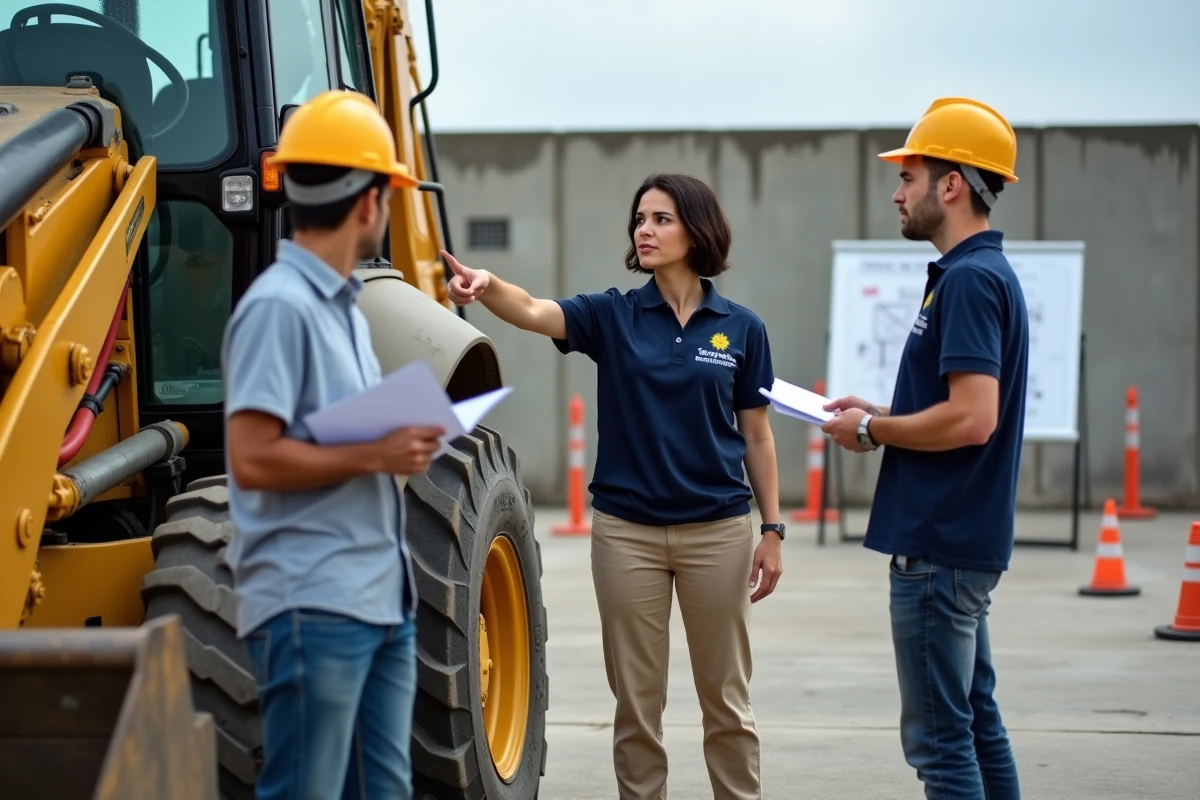
Triple condition to drive a backhoe loader on public roads
When a backhoe loader is traveling on an open road, three elements must be met simultaneously. The absence of any one of them may be sufficient for an insurer to reduce or even deny compensation in the event of a claim.
- Driving license appropriate for the vehicle’s authorized total weight (PTAC): a category B license covers vehicles up to 3.5 tons. Beyond that, a category C1 or C license (as defined by the Highway Code) becomes mandatory depending on the total authorized weight.
- CACES R482 currently valid: this certificate validates the theoretical and practical skills of the driver for the relevant category of machine. It has a limited validity period and must be renewed before expiration.
- Written driving authorization issued by the employer: even a driver holding the CACES cannot use the machine without this document. The employer checks the medical fitness, the possession of the CACES, and issues a nominative authorization.
Insurers like SMABTP and MMA Entreprises have tightened their RC/BTP clauses between 2022 and 2024 on this specific point. The triple condition is no longer just a good practice recommendation, it is a contractual requirement in most recent policies.
Driving authorization: the document that employers neglect
The CACES is issued by a certified testing organization. The driving authorization, on the other hand, falls directly under the employer’s responsibility. These are two distinct acts, and the latter is the one most often missing from control files.
Content and conditions for issuance
The employer can only sign this authorization after verifying three points: the possession of a valid CACES for the category of machine, the compliance of the medical fitness certificate issued by the occupational physician, and the knowledge of the work site and conditions. The authorization is nominative and linked to an employer. A temporary worker or an external contractor must obtain a new authorization from the user company.
Territorial public service: a recent alignment
On municipal and community construction sites, the territorial public service is beginning to require the same combination as the private sector. Until recently, some municipal services tolerated the operation of backhoe loaders on site with only a driving license. This tolerance is gradually disappearing, with communities aligning on the triple condition to limit their liability in the event of an accident.

CACES R482 category C1 training: process and renewal
The training for CACES R482 category C1 is divided into two parts. The theoretical module covers regulations, construction machinery technology, risk identification, and site traffic rules. The practical module focuses on handling, loading and earthmoving maneuvers, as well as basic maintenance.
The final assessment combines a theoretical test and a practical test, both conducted by an independent certified tester from the training organization. Success in both tests is required to obtain the certificate.
The renewal of the CACES must occur before the expiration date. A driver whose certificate has expired can no longer receive a valid driving authorization, even if their practical skills have not changed. The recycling course covers part of the initial program, with a complete assessment.
Backhoe loader on the road: specific traffic regulations
A construction machine using public roads is subject to signage and speed obligations. The backhoe loader must be equipped with a flashing light, reflective devices, and, depending on the case, exceptional convoy signage if its dimensions exceed standard limits.
The maximum authorized speed depends on the category of machine and its homologation. Most backhoe loaders are not designed to exceed moderate speeds on the road, which often requires a suitable route to avoid high-traffic areas.
The driving license appropriate for the PTAC remains mandatory for any journey on public roads, even for a move of a few hundred meters between two construction sites. The CACES alone does not confer any road traffic rights.
Communities and clients are increasingly integrating this triple verification into their calls for tenders. A craftsman or company that cannot justify the compliance of its drivers risks being excluded from a contract even before the price question arises. Compliance is not only a legal protection, but it also conditions access to construction sites.