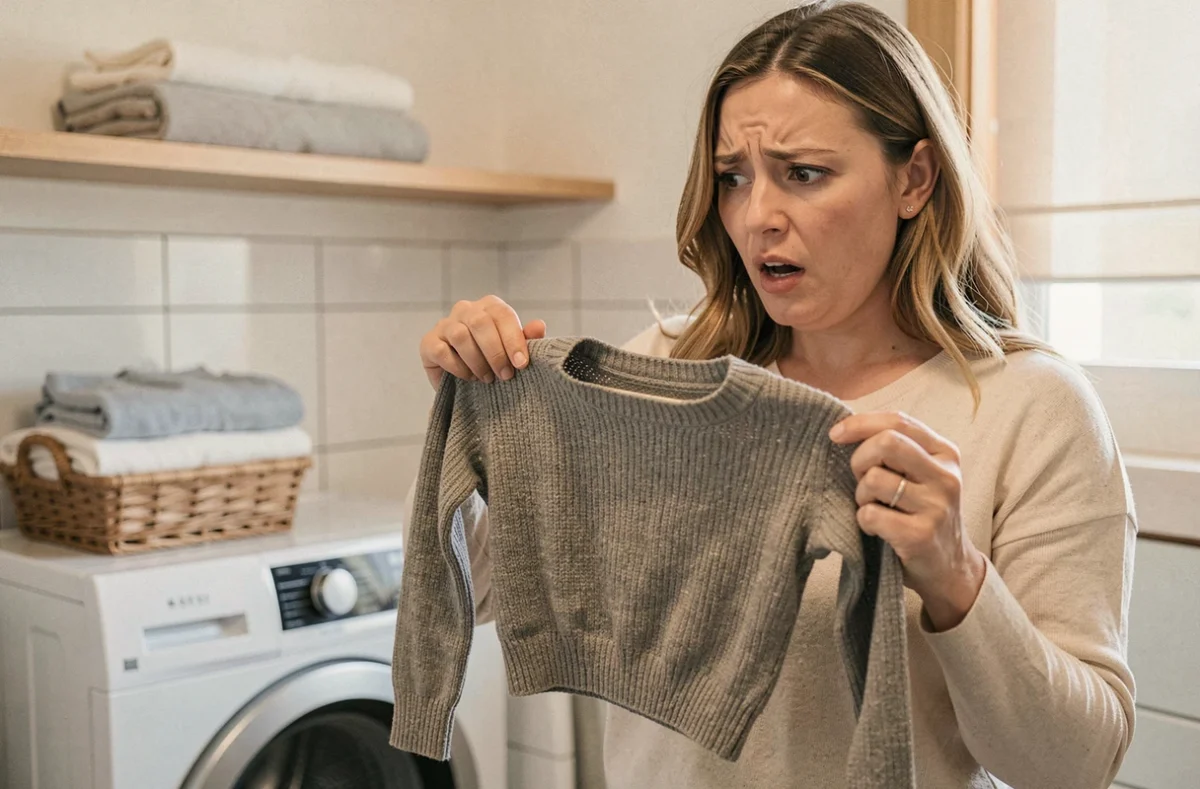
A cotton sweater that comes out of the washing machine two sizes smaller than when it went in: we’ve all experienced it at least once. Laundry that shrinks at 60 °C is a real problem, because that’s often the temperature we instinctively choose for household linens or stained clothes.
Shrinkage at this temperature isn’t random: it results from a specific physical process linked to the structure of textile fibers, and not all materials react in the same way.
Irreversible deformation after 60 °C: what really happens to the fibers
During spinning, cotton fibers are mechanically stretched to create an even, taut yarn. When exposed to hot water and the agitation of the drum, these fibers try to return to their original, more compact shape. This is known as residual shrinkage.
At 30 or 40 °C, shrinkage remains moderate. At 60 °C, the heat dramatically accelerates the tightening of the fibers, especially during the first wash at this temperature. Cotton, linen, and cotton gauze are the most vulnerable.
Wool shrinks through a different process. Its surface scales open under the combined effects of heat and friction, then interlock permanently. This is called felting. So the question of whether laundry shrinks at 60 °C calls for a nuanced answer depending on the fiber: a thick cotton garment may lose a few centimeters, while a fine wool garment may be beyond recovery.
Synthetics (polyester, nylon) are more heat-resistant, but a prolonged wash at 60 °C can still cause slight deformation in cotton-polyester blends, where the cotton shrinks while the synthetic fibers retain their dimensions. The garment then becomes unevenly misshapen.
Restoring a garment that shrank at 60 °C: realistic technique or false hope?
You’ll often read that all you need to do is soak a shrunken garment in lukewarm water with conditioner or white vinegar, then gently stretch it back into shape. This method works in some cases, but it has clear limitations after a wash at 60 °C.
When recovery is still possible
For loosely woven cotton (a basic T-shirt or tank top), soaking it in lukewarm water with hair conditioner can partially relax the fibers. Then lay the garment flat on a towel and stretch it to the desired dimensions, holding it in place as it dries.
The result depends on how much the garment has shrunk. If it has lost half a size, you can often recover most of it. Beyond that, the fibers have shrunk too much.
When you have to accept the loss
Wool that has felted after a wash at 60 °C cannot be unfelted. The scales are mechanically locked together. No soak or product will open them back up. The garment’s structure has changed permanently.
Very fine linen shrinks in a similar way: once the fibers contract at high temperatures, they do not return to their original length. You can soften the fabric, but you cannot get those lost centimeters back.
Washing temperatures and shrinkage: thresholds to know for each material
Prevention is still the most effective approach. Every material has a temperature threshold beyond which the risk of shrinkage rises sharply. The care label provides this information, but we don’t always check it, especially for everyday laundry.
- Standard cotton: safe to wash at 40 °C. At 60 °C, expect some shrinkage during the first wash, especially for items that have not been industrially pre-shrunk.
- Wool and cashmere: use a wool cycle at 30 °C maximum, with a low spin speed. A wash at 60 °C almost always causes felting.
- Linen and cotton gauze: wash at 40 °C on a delicate cycle. Linen can occasionally withstand 60 °C when it is a heavier weave (sheets, dish towels), but fine linen garments will shrink.
- Polyester and synthetic blends: can withstand 60 °C without significant shrinkage. Cotton-synthetic blends may become unevenly misshapen.
The practical rule is simple: only wash thick cotton household linens at 60 °C (sheets, towels, dish towels), along with garments whose labels explicitly allow it.

Spin cycles and tumble dryers: the two overlooked causes of shrinkage
Water temperature isn’t the only factor. High-speed spinning subjects fibers to centrifugal force, compressing the fabric and increasing the shrinkage that began during the wash.
A maximum-speed spin on cotton washed at 60 °C combines two mechanical stresses. Lowering the spin speed by one setting (from 1,200 to 800 rpm, for example) limits this effect without significantly extending drying time.
The tumble dryer is the most critical step after a hot wash. The heat in the drum prolongs and worsens the shrinkage already triggered by water at 60 °C. For delicate materials, air-drying is the only reliable option.
For household linens that always go in the dryer, a low-temperature or “delicate” cycle reduces the risk. Removing the laundry while it is still slightly damp and letting it finish drying flat gives better results than running a full cycle.
Reading the care label isn’t enough: common everyday pitfalls
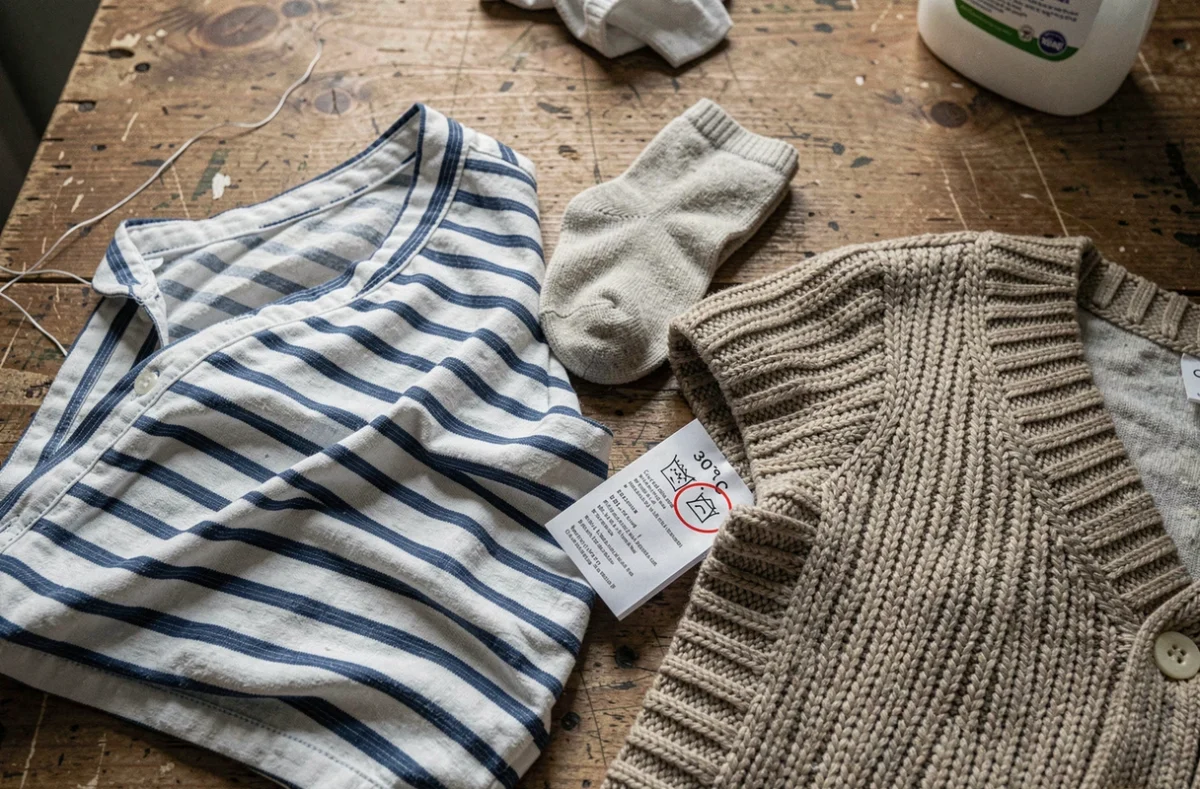
The care label indicates the maximum temperature, not the ideal temperature. A cotton T-shirt marked “60 °C” can withstand that heat, but it will retain its shape better at 40 °C. The care instructions set a limit for what the garment can withstand, not a recommendation for everyday use.
Another common pitfall is mixing items that can withstand 60 °C with others that cannot in the same cycle. Accidentally tossing a wool sweater into a machine set for bath towels is a sure way to cause felting.
Sorting laundry by material rather than by color prevents most mishaps. Separating a “thick cotton at 60 °C” load from a “delicate fibers at 30 °C” load means running an extra cycle, but it protects fragile items.
Shrinkage at 60 °C is no surprise once you understand how each fiber behaves. The only items that can safely withstand this temperature are those designed for it: dense cotton bed linen, terry towels, and dish towels. For everything else, 40 °C meets most cleaning needs without putting the fibers under stress.