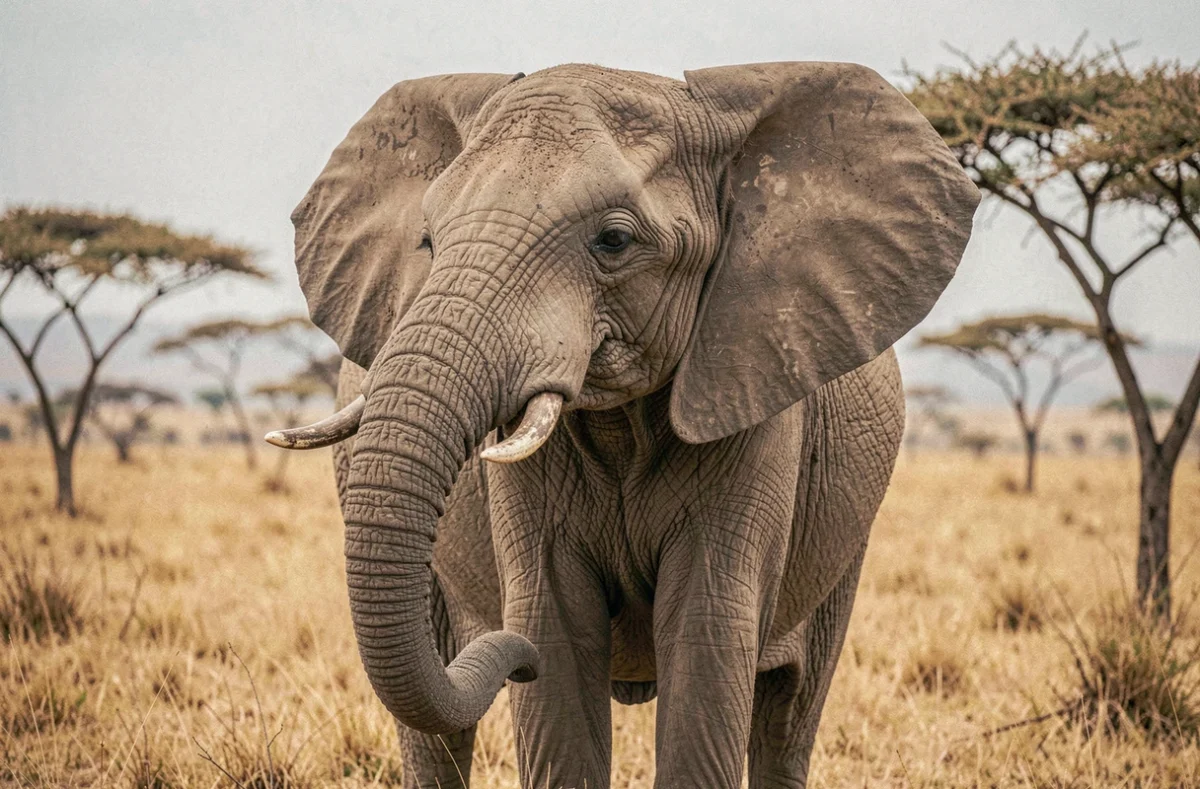
Some animal species modify their behavior from one population to another, much like humans who speak different dialects. This observation, long reserved for primatologists, now informs conservation programs and wildlife tracking technologies. The fascinating animals of the world are not just about spectacular photos: behind each portrait lie survival strategies, cognitive abilities, and social interactions that challenge what we thought we knew.
Animal Culture and Conservation: A Perspective Taken Seriously by Science
Have you ever noticed that two dogs of the same breed, raised in different families, do not react the same way at all? On another scale, this phenomenon exists among wild great apes.
In September 2026, the German research center iDiv launched a group dedicated to behavioral conservation in chimpanzees and bonobos. The idea is simple: each population of great apes has its own traditions (tools used, foraging techniques, social codes). Losing a population is not just losing individuals. It is losing a know-how passed down from generation to generation.
This program aims to integrate these cultural differences into protection plans. A group of chimpanzees that cracks nuts with flat stones will not be managed the same way as a neighboring group that fishes for termites with twigs. Protecting biodiversity now includes behavioral diversity, not just genetic diversity.
To keep up with the latest discoveries and find detailed portraits, animals on Animal News offer a regularly updated feed.
Artificial Intelligence and Wildlife Monitoring
Counting animals in a dense forest or steep mountain has long relied on slow methods: camera traps checked by hand, transects walked on foot, visual identification image by image. Artificial intelligence is changing the game.
Camera Traps and Automated Analysis
The MammAlps dataset, published on September 19, 2026, is based on videos of wild mammals recorded in the Swiss national park. The goal: to automatically compare the behaviors of filmed species using multimodal analysis (image, movement sequence, temporal context).
Before this approach, a researcher had to watch hundreds of hours of video to distinguish a resting deer from an alert one. The algorithm learns to recognize these postures on its own, then flags unusual sequences.
Anticipating Conflicts Between Wildlife and Populations
A systematic review published at the end of September 2026 shows that machine learning is also used to trigger early alerts in case of human-animal conflict. Specifically, when an elephant approaches a cultivated area, the system can warn farmers before damage occurs.
This type of device reduces agricultural losses and, in parallel, decreases retaliation against wildlife. The benefit is twofold: fewer destroyed crops, fewer animals killed out of frustration.
Ecological Corridors: When Animals Travel Outside Parks
Protected areas are not always sufficient. A national park, no matter how vast, cannot contain all the genetic diversity of a species. Animals need to move to find mates, colonize new territories, and avoid inbreeding.
A striking example comes from African wild dogs. Three individuals traveled over 4,000 kilometers to find breeding partners. This colossal journey illustrates how corridors between protected areas condition the survival of endangered species.
Without safe passages between two reserves, populations remain isolated. Genetic diversity collapses, diseases spread more quickly, and the capacity to adapt decreases.
Keeping Up with Animal News: What’s Changing in Access to Information
The landscape of animal information has transformed in recent years. Scientific publications, once reserved for subscribers of specialized journals, are increasingly accessible in open access. Collaborative databases (citizen observations, shared photographic surveys) complement the work of professional naturalists.
For a curious reader, the difficulty is no longer finding information, but sorting what is reliable. A simple tip: prioritize sources that cite their references and clearly distinguish facts from hypotheses.
The animals of the world continue to reveal abilities that science had not anticipated. Culture in great apes, thousands of kilometers traveled by wild dogs: each discovery reminds us that biodiversity is not only measured by the number of species. It is also reflected in the richness of behaviors, strategies, and interactions that define the uniqueness of each animal population.